One of the biggest challenges in modern AI engineering is safely handling large language model outputs.
At first glance, parsing AI responses may seem simple:
- send a prompt,
- receive text,
- use the result.
But in production systems, this quickly becomes dangerous.
LLMs can:
- hallucinate,
- change formatting,
- omit fields,
- generate malformed JSON,
- mix explanations with data,
- or produce inconsistent structures.
If applications trust these outputs blindly, workflows become fragile very quickly.
This is why safe parsing has become one of the most important disciplines in modern AI engineering.
Frameworks like PydanticAI strongly emphasize:
- structured outputs,
- schema validation,
- typed parsing,
- and safe AI workflows.
This article explains:
- why parsing AI outputs is difficult,
- common parsing failures,
- safe parsing strategies,
- and how Python developers can build more reliable AI systems.
What Does “Parsing” Mean?
Parsing means:
- converting raw AI output into structured data the application can safely use.
Example:
Raw LLM output:
The user is Alice and her email is alice@example.com.
Parsed application structure:
{ "name": "Alice", "email": "alice@example.com"}
The application transforms:
- freeform text
into:
- machine-readable data.
Why Parsing AI Outputs Is Difficult
LLMs are probabilistic systems.
Even with identical prompts:
- outputs may vary,
- formatting may drift,
- and structure may change.
This creates major reliability challenges.
Example Parsing Failure
Suppose your application expects JSON:
{ "name": "Alice"}
But the model returns:
Sure! Here's the JSON:{ "name": "Alice"}
Now parsing breaks because:
- extra text was added.
This is extremely common.
Why Unsafe Parsing Is Dangerous
Unsafe parsing can cause:
- crashes,
- workflow failures,
- invalid API calls,
- corrupted state,
- and security issues.
Production AI systems must never blindly trust raw outputs.
Traditional Prompting Problem
Many developers rely on prompts like:
Return only valid JSON.
This helps sometimes.
But it does not guarantee correctness.
Models may still:
- add commentary,
- omit fields,
- or generate malformed structures.
Safe Parsing Requires Validation
Reliable systems combine:
- structured schemas,
- validation,
- retries,
- and typed parsing.
This is one reason typed AI systems are becoming increasingly important.
Structured Outputs Solve Many Problems
Instead of parsing arbitrary text, structured outputs enforce schemas.
Example schema:
from pydantic import BaseModelclass UserProfile(BaseModel): name: str email: str
Now outputs can be validated automatically.
Why Typed Schemas Matter
Schemas define:
- expected fields,
- data types,
- and structural rules.
This dramatically improves:
- predictability,
- debugging,
- and reliability.
Parsing with Pydantic
Example:
from pydantic import BaseModelclass Product(BaseModel): name: str price: float
Now invalid data triggers validation errors automatically.
Example failure:
Product( name="Laptop", price="cheap")
Result:
ValidationError
This protects downstream systems.
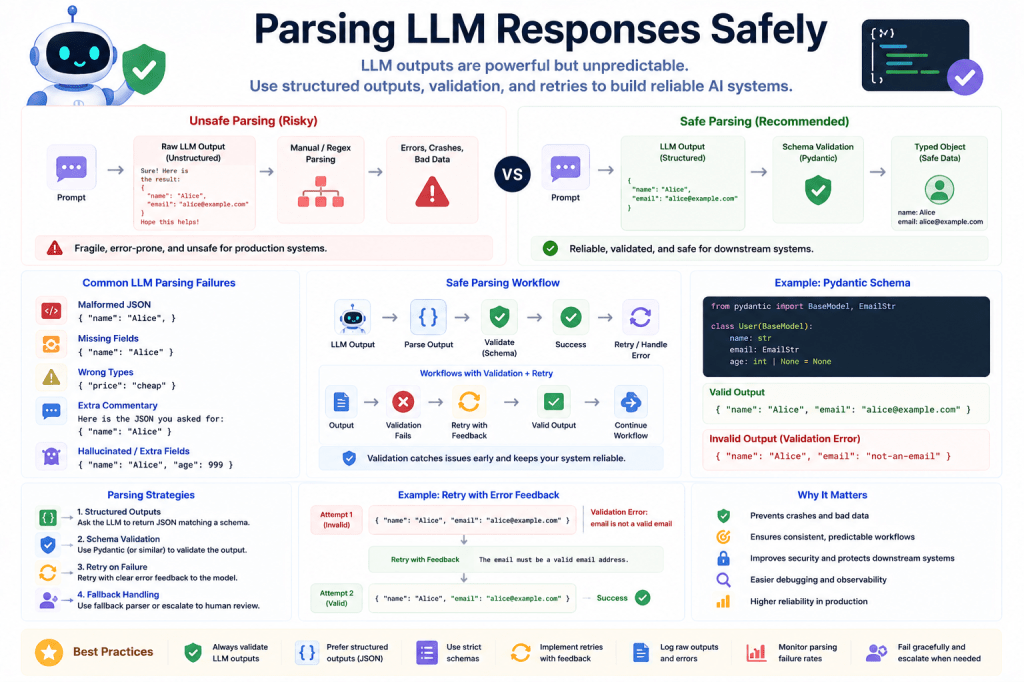
Parsing Raw Text vs Structured Parsing
Unsafe Workflow
Prompt ↓Raw Text ↓Regex Parsing ↓Hope It Works
Fragile and unreliable.
Safe Workflow
Prompt ↓Structured Output ↓Schema Validation ↓Typed Object
Much safer and easier to maintain.
Common LLM Parsing Failures
Production systems encounter many parsing problems.
1. Malformed JSON
Example:
{ "name": "Alice",}
Trailing commas may break strict parsers.
2. Missing Fields
Expected:
{ "name": "Alice", "email": "alice@example.com"}
Actual:
{ "name": "Alice"}
Missing required fields can break workflows.
3. Wrong Types
Expected:
price: float
Actual:
{ "price": "cheap"}
This creates validation failures.
4. Extra Commentary
Example:
Here is the requested JSON:
Additional text often breaks parsers.
5. Hallucinated Fields
LLMs may invent:
- fields,
- properties,
- or structures
that were never requested.
Why Regex Parsing Is Fragile
Many beginners try:
- regular expressions,
- string splitting,
- or ad-hoc parsing.
This becomes extremely difficult to maintain.
AI outputs are inherently variable.
Structured parsing is much safer.
Safe Parsing with Pydantic AI
PydanticAI strongly encourages:
- schema-driven outputs,
- typed parsing,
- and validation-first architectures.
This reduces:
- parsing fragility,
- and workflow instability.
Example Pydantic AI Structured Output
from pydantic_ai import Agentagent = Agent( model="openai:gpt-4o-mini", result_type=UserProfile)
The framework validates outputs automatically.
This dramatically improves reliability.
Parsing and Retry Logic
When parsing fails:
- systems can retry safely.
Workflow:
AI Output ↓Validation Fails ↓Retry Triggered ↓Improved Output Generated
This creates resilient AI pipelines.
Parsing and Tool Calling
Tool calling especially requires safe parsing.
Example:
AI generates tool arguments ↓Arguments validated ↓Tool executes safely
Without validation:
- incorrect API calls may occur.
Parsing and Multi-Step Agents
Multi-step workflows depend heavily on:
- structured intermediate outputs.
Example:
Research Agent ↓Structured Findings ↓Analysis Agent
Safe parsing improves:
- coordination,
- orchestration,
- and reliability.
Parsing and Human-in-the-Loop Systems
Structured outputs also improve:
- human review,
- auditing,
- and explainability.
Humans can review:
- typed data,
- instead of unpredictable text blobs.
Defensive Parsing Strategies
Production systems often use:
- schema validation,
- retries,
- sanitization,
- strict typing,
- and fallback logic.
This creates much safer AI architectures.
Fallback Parsing
Example recovery workflow:
Strict Parsing Fails ↓Retry Attempt ↓Fallback Parser ↓Human Escalation
Graceful failure handling is essential.
Why Observability Matters
Good systems log:
- raw outputs,
- validation failures,
- parsing errors,
- and retry attempts.
Without observability:
- debugging becomes extremely difficult.
Why Python Developers Should Care
Python already has excellent tooling for:
- validation,
- parsing,
- serialization,
- APIs,
- and structured schemas.
This makes Python ideal for reliable AI orchestration systems.
Parsing and APIs
Modern AI systems increasingly integrate with:
- APIs,
- databases,
- automation workflows,
- and enterprise infrastructure.
Safe parsing protects these downstream systems.
Parsing and Security
Unsafe parsing can create:
- injection risks,
- malformed requests,
- corrupted workflows,
- or unintended execution paths.
Validation is also a security mechanism.
Common Beginner Mistakes
1. Trusting AI Outputs Blindly
Always validate generated data.
2. Parsing with Regex Everywhere
Structured schemas are much safer.
3. Ignoring Validation Errors
Validation errors are valuable signals.
4. Treating Parsing as a Minor Detail
Parsing reliability becomes critical quickly.
Real-World Use Cases
Safe parsing is essential in:
- AI agents,
- workflow automation,
- coding assistants,
- retrieval systems,
- enterprise AI,
- customer support systems,
- and orchestration platforms.
The Bigger Industry Trend
The AI industry is rapidly moving toward:
- structured outputs,
- typed schemas,
- validation-first architectures,
- and reliable orchestration systems.
Safe parsing sits at the center of this evolution.
Parsing Reliability Is Production Reliability
One important realization:
Many AI workflow failures are not caused by:
- model intelligence.
They are caused by:
- fragile parsing systems.
Reliable parsing dramatically improves overall system stability.
What You Should Learn Next
Recommended next tutorials:
- AI Output Validation Strategies
- Structured Outputs Explained
- Retrieval-Augmented Generation (RAG) Explained
- Agent Orchestration with LangGraph
- Observability for AI Systems
These topics build directly on reliable AI workflow engineering.
Final Thoughts
Parsing LLM responses safely is one of the most important skills in modern AI engineering.
Raw AI outputs are inherently:
- variable,
- probabilistic,
- and sometimes unreliable.
Production AI systems must therefore combine:
- structured schemas,
- validation,
- retries,
- typed parsing,
- and recovery workflows.
Frameworks like Pydantic AI strongly embrace this philosophy because:
- typed outputs,
- structured validation,
- and schema-driven design
dramatically improve AI system reliability.
As AI systems become increasingly integrated into:
- APIs,
- workflows,
- enterprise systems,
- and automation platforms,
safe parsing will become even more critical.
Reliable AI systems begin with reliable structured data handling.
 Learn Pydantic AI