One of the biggest problems in AI development is unpredictability.
Large language models are incredibly powerful, but they often generate:
- inconsistent formatting,
- malformed JSON,
- missing fields,
- incorrect data types,
- or outputs that are difficult to use programmatically.
This creates major challenges for developers trying to build production-ready AI systems.
That is why structured outputs have become one of the most important concepts in modern AI engineering.
In PydanticAI, structured outputs allow developers to transform AI responses into validated Python objects instead of unreliable blocks of text.
This article explains:
- what structured outputs are,
- why they matter,
- how they work,
- and why they are essential for building reliable AI agents.
What Are Structured Outputs?
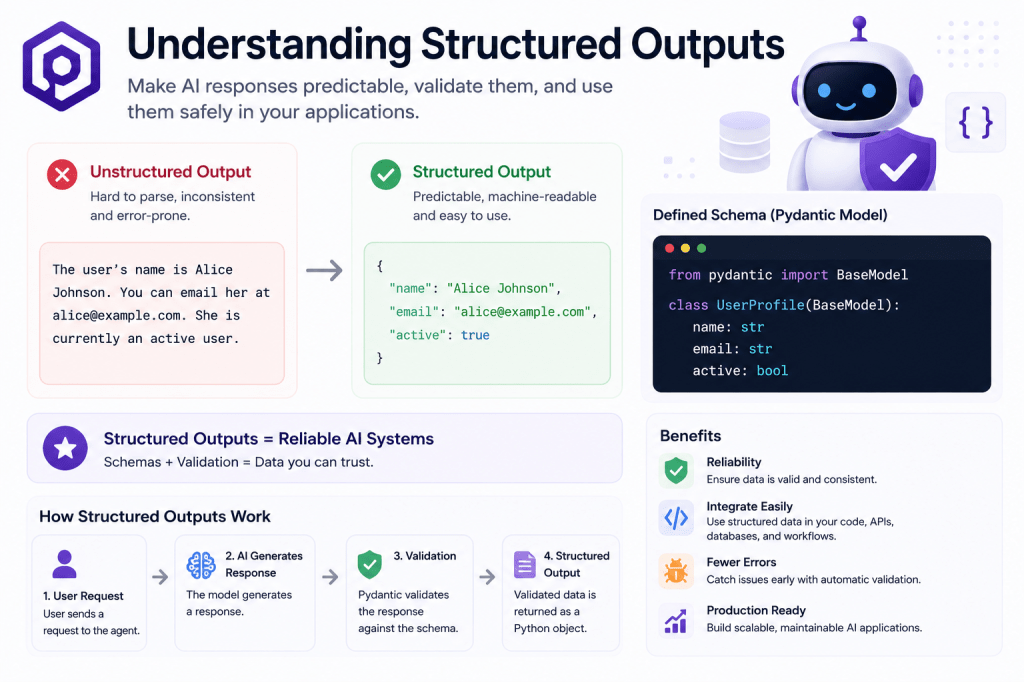
Structured outputs are AI responses that follow a predefined schema or data structure.
Instead of returning freeform text like this:
The user's name is Alice and her email is alice@example.com.
the AI returns validated structured data like this:
{ "name": "Alice", "email": "alice@example.com", "active": true}
This makes the response:
- predictable,
- machine-readable,
- and safe to use inside applications.
Why Structured Outputs Matter
Traditional AI prompting often relies on parsing raw text.
For example, developers might ask:
Return customer information as JSON.
Sometimes the model obeys perfectly.
Sometimes it does not.
The output might contain:
- extra text,
- invalid formatting,
- missing commas,
- or inconsistent fields.
That unpredictability becomes dangerous in production systems.
Structured outputs solve this problem by enforcing schemas and validation rules.
The Core Idea
The core principle is simple:
AI outputs should behave like application data.
Instead of treating model responses as text blobs, developers define exactly what valid output should look like.
Example schema:
from pydantic import BaseModelclass UserProfile(BaseModel): name: str email: str active: bool
Now the AI system knows:
- required fields,
- expected data types,
- and structural rules.
Structured Outputs vs Freeform Text
Freeform AI Output
Alice Johnson is an active user.You can contact her at alice@example.com.
Human-readable:
✅ Yes
Reliable for software systems:
❌ No
Structured Output
{ "name": "Alice Johnson", "email": "alice@example.com", "active": true}
Human-readable:
✅ Yes
Reliable for software systems:
✅ Yes
Why AI Systems Need Structure
As AI systems grow larger, structure becomes increasingly important.
Modern AI applications often:
- call APIs,
- query databases,
- automate workflows,
- generate reports,
- and execute business actions.
All of these systems require predictable data.
Without structure:
- automation breaks,
- parsing becomes fragile,
- debugging becomes difficult,
- and failures become common.
Structured outputs reduce those risks dramatically.
How Pydantic AI Uses Structured Outputs
Pydantic plays a central role in Pydantic AI.
Schemas are defined using Python classes.
Example:
from pydantic import BaseModelclass Product(BaseModel): name: str price: float in_stock: bool
The AI response is automatically:
- generated,
- parsed,
- validated,
- and converted into a Python object.
This creates much more reliable workflows.
Example Without Structured Outputs
Suppose you ask an AI model:
Generate product information.
The response might look like:
Product: LaptopPrice: around $1200Available: yes
This becomes difficult to parse reliably.
Questions arise:
- Is price numeric?
- Is “yes” a boolean?
- What happens if formatting changes?
This is where many AI systems become fragile.
Example With Structured Outputs
Now compare that to a schema-driven system:
class Product(BaseModel): name: str price: float in_stock: bool
Validated result:
{ "name": "Laptop", "price": 1200.00, "in_stock": true}
This data can immediately be used inside:
- APIs,
- databases,
- dashboards,
- workflows,
- and applications.
Validation Is the Key
Structured outputs are powerful because they introduce validation.
Validation checks:
- required fields,
- correct data types,
- formatting rules,
- and schema consistency.
If the output is invalid:
- the system can retry,
- reject the response,
- or handle errors safely.
This dramatically improves reliability.
Example Validation Failure
Suppose the AI returns:
{ "name": "Laptop", "price": "cheap"}
Problems:
priceshould be a floatin_stockis missing
Pydantic validation catches these issues automatically.
Without structured validation, these problems might silently break production systems.
Structured Outputs and AI Agents
Structured outputs become even more important when building AI agents.
Agents frequently:
- interact with APIs,
- execute functions,
- coordinate workflows,
- and pass data between systems.
Unstructured text is unreliable in these scenarios.
Structured data enables:
- safer automation,
- more predictable workflows,
- and easier debugging.
Real-World Use Cases
Structured outputs are used in many practical AI systems.
Data Extraction
Extract:
- invoices,
- customer records,
- medical information,
- contracts,
- or product data.
AI Research Agents
Return structured research summaries.
Workflow Automation
Generate validated actions for business systems.
API Integration
Pass AI-generated data directly into APIs.
AI Dashboards
Generate structured analytics data.
Multi-Agent Systems
Allow agents to exchange reliable structured information.
Structured Outputs Improve Reliability
One of the biggest challenges in AI engineering is consistency.
Without structure:
- outputs drift,
- formatting changes,
- and parsing logic becomes fragile.
Structured outputs create:
- consistency,
- predictability,
- and maintainability.
This becomes critical as AI systems scale.
Structured Outputs vs Prompt Engineering Alone
Traditional prompt engineering often relies on instructions like:
Return valid JSON only.Do not include explanations.
This helps — but it is not guaranteed.
Models can still:
- hallucinate,
- add extra text,
- or generate invalid structures.
Structured validation provides a second layer of protection.
Nested Structured Outputs
Schemas can also become more advanced.
Example:
class Address(BaseModel): city: str country: strclass User(BaseModel): name: str email: str address: Address
This allows AI systems to generate complex structured objects.
Nested models become extremely useful in:
- business applications,
- workflow automation,
- and API orchestration.
Structured Outputs and Type Safety
Type safety means:
- strings remain strings,
- numbers remain numbers,
- booleans remain booleans.
This may sound simple, but it is extremely important in software systems.
Type-safe AI outputs are:
- easier to trust,
- easier to validate,
- and easier to integrate.
Why Structured Outputs Are Becoming Standard
The AI industry is moving rapidly toward:
- tool calling,
- schema validation,
- typed responses,
- and structured workflows.
Major AI providers now support:
- JSON modes,
- function calling,
- and schema-driven generation.
This trend exists because production AI systems require reliability.
Structured outputs are becoming a foundational engineering practice.
Common Beginner Mistakes
1. Using Raw Text Everywhere
Many beginners rely entirely on freeform responses.
This quickly becomes difficult to maintain.
2. Skipping Validation
Validation is one of the biggest advantages of Pydantic AI.
Do not ignore it3. Overcomplicated Schemas Too Early
Start with simple models first.
Build complexity gradually.
4. Treating AI Responses as Fully Trustworthy
Always validate outputs before using them in production systems.
What You Should Learn Next
Now that you understand structured outputs, the next step is learning how schemas work in more detail.
Recommended next tutorials:
- Introduction to Pydantic Models
- Nested Pydantic Models Explained
- Tool Calling Explained
- Building Stateful AI Agents
- AI Output Validation Strategies
These topics build directly on structured AI engineering concepts.
Final Thoughts
Structured outputs are one of the most important ideas in modern AI development.
They transform AI systems from:
- unpredictable text generators
into:
- reliable software components.
By combining:
- schemas,
- validation,
- typed models,
- and structured workflows,
developers can build AI systems that are far more dependable and production-ready.
Pydantic AI makes structured AI engineering accessible to Python developers, and structured outputs sit at the center of that entire approach.
👉 You can experiment with a practical PydanticAI implementation of this concept in the official GitHub repository for the LearnPydanticAI examples: https://github.com/BenardoKemp/learn-pydantic-ai
 Learn Pydantic AI