One of the biggest differences between a simple chatbot and a true AI agent is state.
Basic AI systems often behave like short-term conversations:
- they answer a prompt,
- generate a response,
- and forget everything afterward.
Stateful AI agents work differently.
They can:
- remember previous interactions,
- maintain workflow context,
- track goals,
- store intermediate results,
- and continue long-running tasks across multiple steps.
This ability to maintain state is one of the foundations of modern AI agents.
In frameworks like PydanticAI, stateful architectures help developers build:
- intelligent assistants,
- workflow automation systems,
- retrieval pipelines,
- planning agents,
- and production-ready autonomous systems.
This article explains:
- what stateful AI agents are,
- why state matters,
- how stateful workflows operate,
- and how Python developers can begin building them.
What Is State in an AI System?
State refers to information preserved across interactions or workflow steps.
Examples:
- conversation history,
- task progress,
- memory,
- user preferences,
- workflow variables,
- retrieved documents,
- or execution context.
Without state:
- every request starts from zero.
With state:
- the agent can continue reasoning over time.
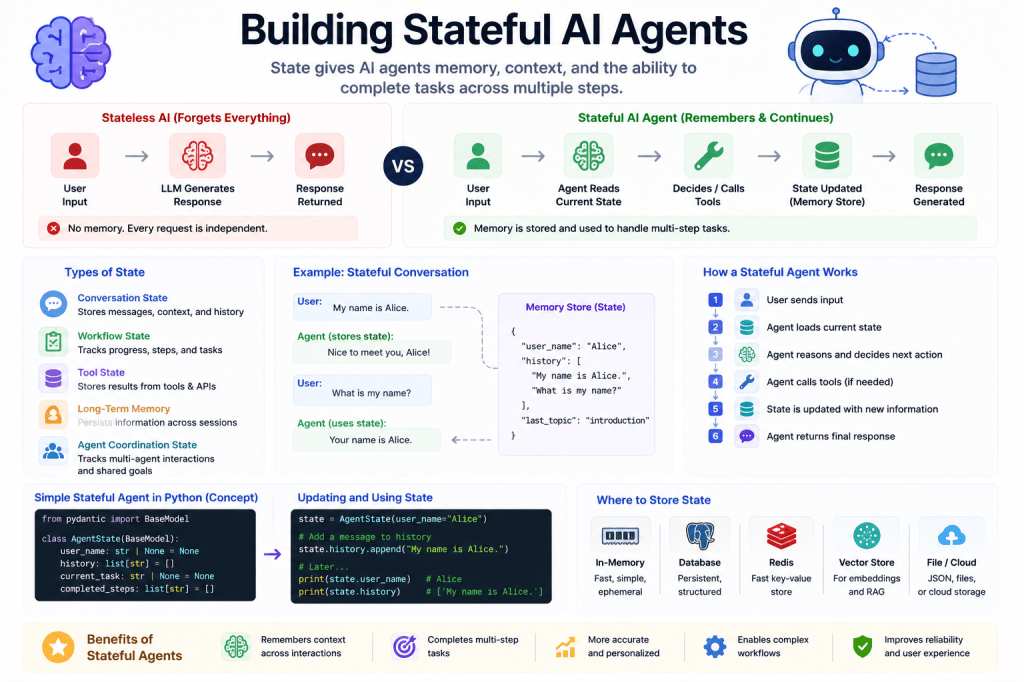
Stateless vs Stateful AI Systems
This distinction is critical.
Stateless AI System
User Prompt ↓LLM Response ↓Conversation Ends
No memory is retained.
Every interaction is isolated.
Stateful AI System
User Prompt ↓Agent Updates Memory ↓Workflow Continues ↓Agent Uses Previous Context ↓Response Generated
The system maintains continuity across interactions.
Why Stateful Agents Matter
Most real-world workflows require memory.
Examples:
- customer support systems,
- research assistants,
- coding agents,
- planning systems,
- and automation pipelines.
Without state:
- workflows become fragmented,
- repetitive,
- and unreliable.
Stateful systems create:
- continuity,
- personalization,
- and long-term reasoning.
Example: Stateless Chatbot
User:
"My name is Alice."
Later:
"What is my name?"
A stateless system may fail because:
- previous context was lost.
Example: Stateful Agent
A stateful agent remembers:
User name = Alice
Now the system can respond correctly later.
This simple example demonstrates the power of state.
Types of State in AI Agents
State can take many forms.
1. Conversation State
Stores:
- previous messages,
- user context,
- interaction history.
Used in:
- assistants,
- support systems,
- chat agents.
2. Workflow State
Tracks:
- execution progress,
- completed steps,
- pending actions.
Used in:
- automation systems,
- orchestration pipelines.
3. Tool State
Stores:
- retrieved data,
- API results,
- database outputs.
Used in:
- tool-calling systems,
- retrieval workflows.
4. Long-Term Memory
Persists information across sessions.
Examples:
- user preferences,
- saved notes,
- historical interactions.
5. Agent Coordination State
Tracks:
- multi-agent interactions,
- shared objectives,
- execution status.
Used in:
- orchestration systems,
- collaborative agents.
Why Stateful Agents Are More Powerful
Stateful agents can:
- continue tasks,
- remember goals,
- refine reasoning,
- and coordinate workflows.
This creates systems that feel much more intelligent.
Without state:
- agents behave like isolated prompt-response systems.
With state:
- agents become workflow participants.
Simple Stateful Architecture
Example:
User Input ↓Memory Store Updated ↓Agent Reads Existing State ↓Reasoning Step ↓Response Generated
This architecture forms the basis of many modern AI systems.
Stateful AI Agents in Python
Python is especially good for stateful systems because it already supports:
- databases,
- APIs,
- caching,
- serialization,
- async execution,
- and backend architectures.
This makes Python ideal for AI orchestration.
Simple State Example
Basic state storage:
conversation_state = { "user_name": "Alice", "last_topic": "AI agents"}
The agent can reuse this information later.
Example Stateful Agent Concept
from pydantic import BaseModelclass AgentState(BaseModel): user_name: str current_task: str completed_steps: list[str]
This creates structured and validated agent memory.
Why Structured State Matters
Without schemas:
- memory becomes inconsistent,
- workflows become fragile,
- and debugging becomes difficult.
Structured state improves:
- reliability,
- maintainability,
- and observability.
This strongly aligns with the philosophy of:
PydanticAI
Stateful Agents and Tool Calling
State becomes especially important when agents use tools.
Example workflow:
Retrieve Documents ↓Store Retrieved Data ↓Summarize Results ↓Generate Final Report
The agent must preserve intermediate information across steps.
Stateful Agents and Retrieval Systems
Retrieval-Augmented Generation (RAG) systems rely heavily on state.
Agents may need to track:
- retrieved documents,
- embeddings,
- summaries,
- and conversation context.
Without state:
- retrieval workflows become disconnected.
Stateful Multi-Step Workflows
Many agents execute:
- plans,
- sequences,
- retries,
- and branching workflows.
Example:
Step 1: Gather InformationStep 2: Analyze DataStep 3: Generate SummaryStep 4: Save Results
Each step updates workflow state.
Long-Running AI Agents
Some AI agents may operate for:
- minutes,
- hours,
- or continuously.
Examples:
- monitoring systems,
- research assistants,
- autonomous workflows.
State management becomes essential in these architectures.
Stateful Agents Feel More Intelligent
One major reason stateful agents feel smarter is because they:
- accumulate context,
- adapt behavior,
- and continue workflows over time.
This creates more coherent interactions.
Common Storage Options for State
State can be stored in:
- memory,
- files,
- databases,
- vector stores,
- Redis,
- or cloud systems.
Choice depends on:
- scale,
- persistence needs,
- and architecture complexity.
In-Memory State
Simple example:
memory = {}
Good for:
- experiments,
- prototypes,
- and tutorials.
Not ideal for production systems.
Database State
Production systems often store state in:
- PostgreSQL,
- SQLite,
- Redis,
- MongoDB,
- or vector databases.
This allows:
- persistence,
- scalability,
- and reliability.
Structured State with Pydantic Models
Example:
class ConversationState(BaseModel): user_name: str history: list[str]
This creates:
- validated memory,
- predictable structure,
- and safer workflows.
Stateful Agents and Multi-Agent Systems
Multi-agent architectures often require shared state.
Agents may coordinate:
- tasks,
- plans,
- memory,
- and execution progress.
Shared structured state becomes critical.
Stateful Agents vs Simple Chatbots
This distinction is becoming increasingly important.
Chatbot
Usually:
- short-lived,
- conversational,
- stateless.
Stateful Agent
Usually:
- task-oriented,
- persistent,
- workflow-driven,
- and memory-aware.
Common Beginner Mistakes
1. Treating State as an Afterthought
State management becomes critical quickly.
2. Storing Unstructured Memory
Schemas improve maintainability enormously.
3. Overengineering Memory Too Early
Start simple.
Build complexity gradually.
4. Forgetting State Expiration
Not all memory should persist forever.
Stateful Agents and Production AI
Production AI systems increasingly require:
- memory,
- workflow continuity,
- persistent state,
- and orchestration tracking.
State management is becoming one of the central challenges in AI engineering.
Real-World Use Cases
Stateful agents power:
- AI assistants,
- research systems,
- workflow automation,
- coding agents,
- retrieval systems,
- monitoring platforms,
- and autonomous orchestration pipelines.
The Bigger Industry Trend
Modern AI systems are rapidly evolving toward:
- long-running workflows,
- memory-aware agents,
- orchestration systems,
- and autonomous execution loops.
State management sits at the center of this transition.
What You Should Learn Next
Recommended next tutorials:
- AI Output Validation Strategies
- Multi-Agent Architectures Explained
- Retrieval-Augmented Generation (RAG) Explained
- Parsing LLM Responses Safely
- AI Agent Retry Logic and Failure Recovery
These topics build directly on stateful workflow design.
Final Thoughts
Stateful AI agents represent a major evolution beyond traditional chatbots.
By maintaining:
- memory,
- workflow context,
- execution history,
- and structured state,
agents become capable of:
- longer reasoning chains,
- complex workflows,
- and more intelligent automation.
As AI systems become increasingly autonomous and production-oriented, state management will become one of the most important skills for AI engineers to understand.
Frameworks like Pydantic AI help developers build these systems more safely using:
- structured schemas,
- typed workflows,
- validation,
- and maintainable architectures.
State is one of the key building blocks that transforms AI from conversation into true orchestration.
 Learn Pydantic AI