As AI systems become more advanced, they also become more demanding.
Modern AI agents often need to:
- call APIs,
- retrieve documents,
- query databases,
- run multiple tools,
- orchestrate workflows,
- and coordinate multiple agents simultaneously.
If these tasks execute one-by-one in a blocking manner, systems quickly become:
- slow,
- inefficient,
- and difficult to scale.
This is where asynchronous programming becomes critically important.
Async AI agents allow Python applications to:
- handle multiple operations concurrently,
- reduce waiting time,
- improve responsiveness,
- and scale more efficiently.
Frameworks like PydanticAI increasingly benefit from async architectures because modern AI systems rely heavily on:
- APIs,
- network requests,
- orchestration pipelines,
- and parallel execution.
This article explains:
- what async programming is,
- why it matters for AI agents,
- how asynchronous workflows operate,
- and how Python developers can build async AI systems.
What Does “Async” Mean?
Async (asynchronous) programming allows Python programs to:
- continue working while waiting for other tasks to complete.
Instead of:
- stopping execution during slow operations,
the system can:
- switch to other tasks meanwhile.
This dramatically improves efficiency.
Why AI Systems Need Async Programming
AI agents frequently spend time waiting for:
- API responses,
- database queries,
- web requests,
- vector searches,
- or tool execution.
Without async programming:
- the application blocks during each wait.
This wastes time and resources.
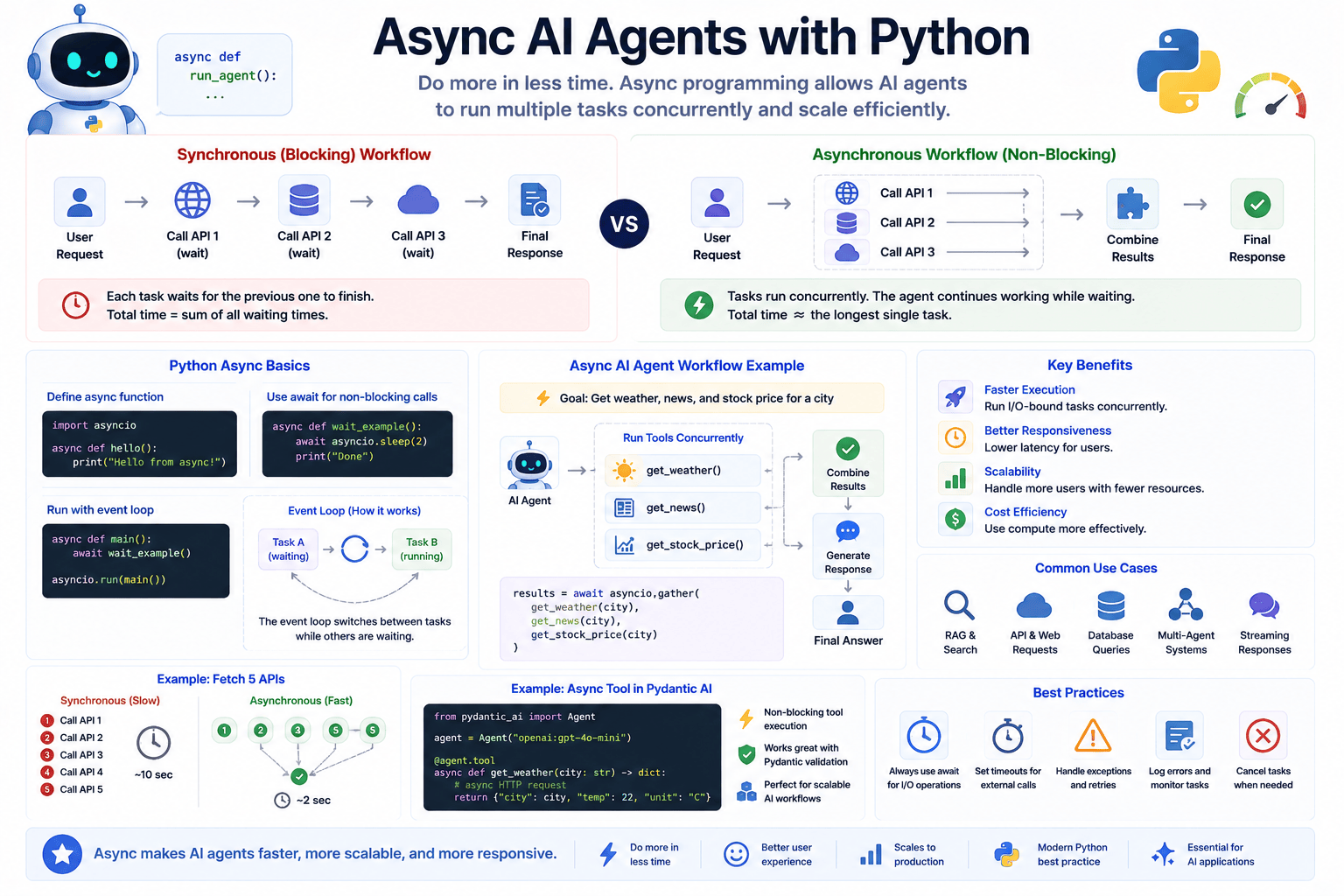
Blocking Workflow Example
Traditional synchronous workflow:
Request API ↓Wait... ↓Receive Response ↓Continue Execution
Nothing else happens during the waiting period.
Async Workflow Example
Asynchronous workflow:
Request API ↓Switch To Other Task ↓API Response Arrives ↓Resume Execution
This allows the system to:
- multitask efficiently.
Why Async Matters for AI Agents
Modern AI agents often:
- use multiple tools,
- coordinate workflows,
- retrieve documents,
- and manage concurrent tasks.
Async execution improves:
- speed,
- responsiveness,
- scalability,
- and throughput.
Simple Example of Waiting
Imagine an AI agent:
- calling 5 APIs sequentially.
Synchronous execution:
API 1 → WaitAPI 2 → WaitAPI 3 → WaitAPI 4 → WaitAPI 5 → Wait
This can become very slow.
Async Parallel Execution
With async:
API 1API 2API 3API 4API 5 ↓All Execute Concurrently
The total workflow becomes dramatically faster.
Async vs Parallelism
These concepts are related — but different.
Async Programming
Best for:
- waiting-heavy workloads.
Examples:
- APIs,
- databases,
- network calls,
- I/O operations.
Parallel Computing
Best for:
- CPU-heavy workloads.
Examples:
- training models,
- image processing,
- numerical computation.
Why AI Agents Benefit So Much from Async
AI systems are often:
- I/O bound,
- network-heavy,
- and tool-driven.
This makes async programming extremely valuable.
Python Async Basics
Python uses:
async- and
await
for asynchronous programming.
Basic example:
import asyncioasync def say_hello(): print("Hello")
The async keyword defines an asynchronous function.
Using await
Example:
import asyncioasync def wait_example(): await asyncio.sleep(2) print("Done")
await pauses the current task while allowing other tasks to continue.
Why await Is Important
Without await:
- the system blocks execution.
With await:
- the event loop manages concurrency efficiently.
This is the foundation of async Python.
Async AI Tool Calling
Async programming becomes especially powerful for AI tool calling.
Example:
async def fetch_weather(city: str): ...
Now multiple tool calls can run concurrently.
Async AI Workflow Example
Example architecture:
User Request ↓Agent Starts Multiple Tool Calls ↓Tools Execute Concurrently ↓Results Combined ↓Final Response Generated
This significantly improves responsiveness.
Async and Multi-Agent Systems
Multi-agent architectures benefit enormously from async execution.
Example:
Research AgentAnalysis AgentTool AgentRetriever Agent
These agents may execute simultaneously.
Async orchestration makes this scalable.
Async with Pydantic AI
PydanticAI works very naturally with async Python because:
- tool calls,
- APIs,
- and orchestration workflows
often require asynchronous execution.
This makes the framework suitable for:
- scalable agent systems,
- workflow orchestration,
- and production AI applications.
Example Async Tool
Example:
from pydantic_ai import Agentagent = Agent("openai:gpt-4o-mini")@agent.toolasync def get_data(): return "Data loaded"
This allows non-blocking tool execution.
Async API Requests
AI agents frequently interact with:
- OpenAI APIs,
- vector databases,
- cloud systems,
- retrieval services.
Async programming improves performance dramatically in these environments.
Async and Retrieval-Augmented Generation (RAG)
RAG systems often require:
- document retrieval,
- embedding searches,
- and vector queries.
Async execution helps:
- parallelize retrieval workflows,
- and reduce latency.
Async and Streaming Responses
Many AI systems now stream outputs progressively.
Async architectures support:
- real-time streaming,
- live token generation,
- and responsive interfaces.
This improves user experience significantly.
Event Loops Explained
Python async systems use an event loop.
The event loop:
- manages tasks,
- switches execution,
- and coordinates async operations.
Basic concept:
Task A waits ↓Event loop switches to Task B ↓Task A resumes later
This creates efficient concurrency.
Async and Scalability
Async systems can handle:
- many concurrent users,
- many API requests,
- and many workflows
with fewer resources.
This is extremely important for production AI systemsAsync and Failure Recovery
Async systems also require:
- retry logic,
- timeout handling,
- and cancellation management.
Production async systems must be carefully designed.
Async and Timeouts
Example:
await asyncio.wait_for(task(), timeout=5)
This prevents workflows from hanging indefinitely.
Async and Rate Limits
Many APIs enforce:
- request limits,
- concurrency limits,
- and throughput controls.
Async systems help:
- queue requests,
- and manage execution more efficiently.
Async and Workflow Orchestration
Advanced AI systems often orchestrate:
- multiple APIs,
- multiple tools,
- multiple agents,
- and multiple workflows simultaneously.
Async execution becomes foundational at scale.
Why Python Developers Should Learn Async
Async programming is becoming one of the most important skills for:
- AI engineers,
- backend developers,
- and orchestration architects.
Modern AI systems increasingly depend on:
- concurrency,
- orchestration,
- and network-heavy workflows.
Common Beginner Mistakes
1. Forgetting await
Without await:
- async functions may not execute properly.
2. Mixing Blocking Code with Async Code
Blocking operations can freeze async workflows.
3. Overengineering Early Systems
Start simple:
- one async task at a time.
4. Ignoring Timeout Handling
Production systems must handle slow operations safely.
Real-World Use Cases
Async AI agents power:
- AI assistants,
- workflow orchestration systems,
- retrieval systems,
- coding agents,
- monitoring platforms,
- multi-agent systems,
- and enterprise AI infrastructure.
The Bigger Industry Trend
Modern AI systems are rapidly moving toward:
- concurrent workflows,
- streaming architectures,
- multi-agent orchestration,
- and scalable async execution pipelines.
Async programming is becoming a foundational skill in AI engineering.
Async AI Systems Feel Faster
One important observation:
Async systems often feel dramatically more responsive because:
- waiting time becomes hidden behind concurrent execution.
This creates:
- smoother workflows,
- faster interfaces,
- and more scalable applications.
What You Should Learn Next
Recommended next tutorials:
- Async Tool Calling with Pydantic AI
- Agent Orchestration with LangGraph
- AI Output Validation Strategies
- Retrieval-Augmented Generation (RAG) Explained
- Observability for AI Systems
These topics build directly on async AI architecture design.
Final Thoughts
Async AI agents represent one of the most important architectural patterns in modern AI engineering.
As AI systems become increasingly:
- tool-driven,
- API-heavy,
- and orchestration-focused,
asynchronous execution becomes essential for:
- scalability,
- responsiveness,
- and production reliability.
By combining:
- async Python,
- structured outputs,
- tool calling,
- validation,
- and orchestration,
developers can build AI systems that:
- handle concurrent workflows,
- scale efficiently,
- and remain highly responsive.
Frameworks like Pydantic AI work especially well in async environments because:
- modern AI orchestration naturally depends on asynchronous operations.
Async programming is quickly becoming one of the core building blocks behind scalable AI agent systems.