Modern AI agents are becoming far more powerful than simple chatbots.
Today’s AI systems can:
- retrieve live business data,
- analyze records,
- orchestrate workflows,
- generate reports,
- automate operations,
- and interact directly with production databases.
One of the most important databases used in modern AI systems is:
PostgreSQL
PostgreSQL is widely used because it offers:
- reliability,
- scalability,
- structured querying,
- strong indexing,
- JSON support,
- vector database extensions,
- and production-grade performance.
When combined with:
PydanticAI
developers can build AI agents that:
- interact safely with structured data,
- validate workflows,
- execute database tools,
- and orchestrate enterprise-grade automation systems.
This article explains:
- how AI agents interact with PostgreSQL,
- why structured validation matters,
- how Pydantic AI fits into the architecture,
- and how Python developers can begin building PostgreSQL-powered AI systems.
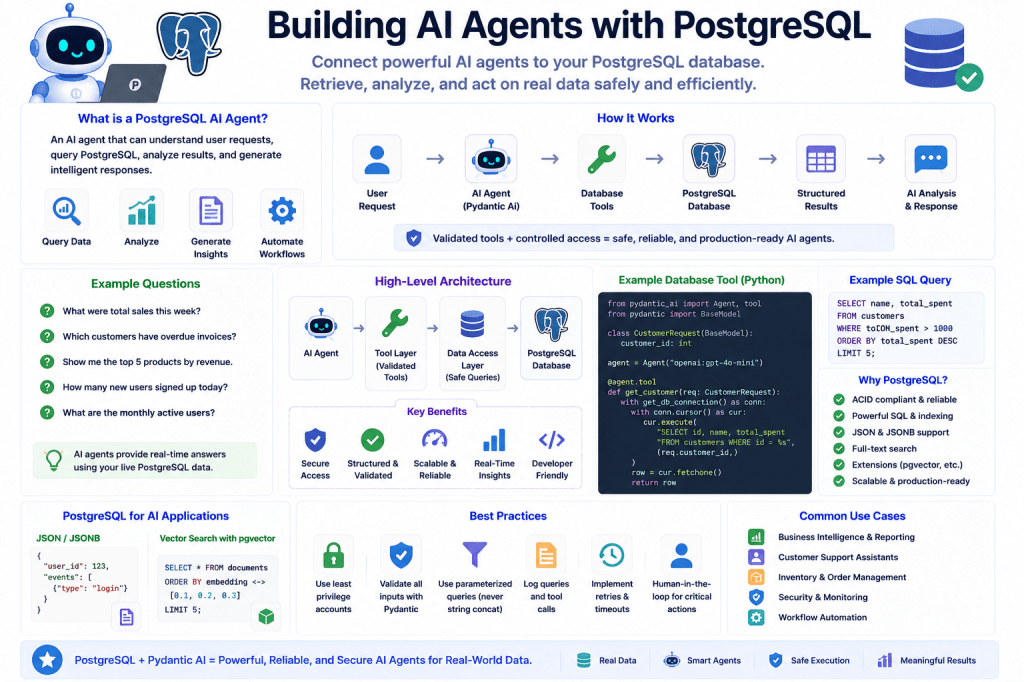
Why PostgreSQL Is Popular for AI Systems
PostgreSQL is one of the most respected relational databases in software engineering.
It is heavily used in:
- SaaS platforms,
- enterprise systems,
- analytics pipelines,
- AI applications,
- and production APIs.
Key advantages include:
- strong SQL support,
- reliability,
- extensibility,
- and scalability.
Why AI Agents Need Databases
Large language models alone are limited because:
- training data becomes outdated,
- private business data is unavailable,
- and workflows require live information.
Databases solve this problem.
AI agents can now:
- retrieve live data,
- analyze operational systems,
- and automate real workflows.
Basic AI Workflow Without Database Access
Traditional AI flow:
User Question ↓LLM Generates Response
The model only uses:
- training knowledge,
- prompts,
- and context windows.
AI Workflow With PostgreSQL
Database-enabled architecture:
User Request ↓AI Agent ↓PostgreSQL Query Tool ↓Structured Results ↓AI Analysis ↓Final Response
Now the AI works with:
- live production data.
Example Use Cases
PostgreSQL AI agents can power:
- customer analytics,
- inventory systems,
- reporting dashboards,
- support assistants,
- cybersecurity monitoring,
- CRM systems,
- and workflow automation.
Example Questions
Users may ask:
"What were total sales this week?"
or:
"Which customers have overdue invoices?"
The AI agent:
- retrieves data,
- analyzes results,
- and generates structured insights.
Why Structured AI Matters
Database systems require:
- strict schemas,
- predictable queries,
- and validated workflows.
Unstructured AI outputs become dangerous quickly in production environments.
This is why:
PydanticAI
is especially valuable.
PostgreSQL and Structured Data
PostgreSQL naturally works with:
- structured records,
- tables,
- relations,
- and typed schemas.
This aligns extremely well with:
- typed AI systems,
- and Pydantic validation models.
Example PostgreSQL Table
Simple table:
CREATE TABLE customers ( id SERIAL PRIMARY KEY, name TEXT, total_spent FLOAT);
The AI agent may query:
- customer information,
- analytics,
- and operational data.
Tool Calling and Database Agents
AI agents usually interact with PostgreSQL through:
- tool calling.
The model decides:
- when to retrieve data,
- what tool to call,
- and how to use the results.
Example Tool
Simple conceptual tool:
@agent.tooldef get_customer(customer_id: int): ...
The AI can now:
- retrieve database information dynamically.
Why Validation Matters
Without validation:
- invalid queries,
- malformed inputs,
- and unsafe execution
can occur.
Validation protects:
- the database,
- the workflow,
- and the application.
Example Validation Model
from pydantic import BaseModelclass CustomerRequest(BaseModel): customer_id: int
This creates:
- typed,
- validated,
- and predictable tool inputs.
Connecting Python to PostgreSQL
Python has excellent PostgreSQL tooling.
Popular libraries include:
- psycopg,
- asyncpg,
- SQLAlchemy,
- and ORM frameworks.
These libraries integrate well with:
- AI orchestration systems.
Example PostgreSQL Query
Simple example:
cursor.execute( "SELECT * FROM customers WHERE id = %s", (customer_id,))
Parameterized queries improve:
- security,
- and reliability.
Never Trust Raw AI SQL Generation
One of the biggest beginner mistakes:
- allowing unrestricted SQL generation.
This can create:
- destructive queries,
- security vulnerabilities,
- data leaks,
- or corrupted databases.
Safer Architecture Pattern
Recommended structure:
AI Agent ↓Validated Tool Layer ↓Controlled Database Functions ↓PostgreSQL
The AI never directly controls:
- unrestricted database execution.
Why Tool Abstractions Matter
Instead of:
"Generate any SQL query."
prefer:
"Use predefined validated tools."
This dramatically improves:
- security,
- maintainability,
- and observability.
Example Structured Tool
Example:
@agent.tooldef get_monthly_sales(month: str): ...
The workflow becomes:
- safer,
- more predictable,
- and easier to debug.
PostgreSQL JSON Support
One major advantage of PostgreSQL:
- excellent JSON support.
PostgreSQL can store:
- structured JSON documents,
- AI outputs,
- workflow state,
- and orchestration metadata.
Example:
SELECT data->>'name'FROM users;
This is extremely useful for AI systems.
PostgreSQL and Vector Search
Modern AI systems increasingly use:
- embeddings,
- semantic search,
- and retrieval pipelines.
PostgreSQL supports vector operations through extensions like:
- pgvector.
This allows PostgreSQL to participate in:
- Retrieval-Augmented Generation (RAG) systems.
Example AI Retrieval Workflow
User Query ↓Embedding Search ↓PostgreSQL Vector Retrieval ↓AI Analysis ↓Final Response
This architecture is becoming increasingly common.
Multi-Step Database Agents
Advanced AI agents may:
- retrieve data,
- analyze patterns,
- generate summaries,
- create recommendations,
- store reports back into PostgreSQL.
This creates sophisticated enterprise workflows.
Example Multi-Step Workflow
Retrieve Sales Data ↓Analyze Trends ↓Generate Summary ↓Store AI Report
This moves AI far beyond:
- simple conversation systems.
Async PostgreSQL Access
Database operations are often:
- network-heavy,
- and waiting-heavy.
Async execution improves:
- scalability,
- throughput,
- and responsiveness.
Example:
async def load_orders(): ...
Async architectures are increasingly important in production AI systems.
PostgreSQL and Multi-Agent Systems
Some advanced systems divide responsibilities across agents.
Example:
Retriever Agent ↓Analytics Agent ↓Reporting Agent
Each agent:
- focuses on a specialized role.
PostgreSQL and Human-in-the-Loop Workflows
Critical workflows may require:
- approvals,
- audits,
- or human review.
Example:
AI Generates Financial Report ↓Human Review ↓Final Approval
This improves:
- trust,
- compliance,
- and operational safety.
Why Observability Matters
Production AI systems should log:
- database queries,
- validation failures,
- retries,
- tool calls,
- and workflow state.
Without observability:
- debugging becomes extremely difficult.
Common PostgreSQL Agent Errors
Common failures include:
- invalid queries,
- missing records,
- timeout failures,
- connection issues,
- schema mismatches,
- and parsing errors.
Robust recovery systems become essential.
Retry Logic for Database Agents
Example:
Database Timeout ↓Retry with Backoff
Production systems require:
- retries,
- fallbacks,
- and graceful recovery logic.
Security Best Practices
Important safeguards include:
- read-only permissions,
- query validation,
- restricted access,
- audit logging,
- and role separation.
Never allow unrestricted database execution from AI systems.
Why Pydantic AI Fits PostgreSQL Workflows Well
PydanticAI strongly supports:
- typed validation,
- structured outputs,
- tool calling,
- and schema-driven orchestration.
This aligns naturally with:
- PostgreSQL’s structured data model.
Recommended Architecture
Typical production design:
User ↓AI Agent ↓Validated Tool Layer ↓PostgreSQL Access Layer ↓Database
This layered architecture improves:
- security,
- maintainability,
- and reliability.
Why Python Developers Should Learn This
Python already dominates:
- AI engineering,
- backend development,
- automation,
- and orchestration.
Combining:
- PostgreSQL,
- Pydantic AI,
- and Python
creates an extremely powerful stack for:
- production AI systems.
Common Beginner Mistakes
1. Allowing Raw SQL Generation
Start with controlled tool layers.
2. Ignoring Validation
Validation is critical for safe workflows.
3. Giving Excessive Database Permissions
Restrict access carefully.
4. Forgetting Monitoring and Logging
Production systems require observability.
Real-World Use Cases
PostgreSQL AI agents are increasingly used in:
- analytics systems,
- enterprise search,
- AI dashboards,
- workflow automation,
- support systems,
- cybersecurity monitoring,
- and business intelligence platforms.
The Bigger Industry Trend
Modern AI engineering is rapidly moving toward:
- database-aware AI systems,
- structured orchestration,
- enterprise automation,
- and retrieval-enhanced workflows.
Database-connected AI agents are becoming foundational infrastructure.
AI Becomes More Valuable With Real Data
One major industry realization is:
AI becomes dramatically more useful when connected to operational systems.
PostgreSQL agents transform AI from:
- isolated text generation
into:
- business-aware infrastructure.
What You Should Learn Next
Recommended next tutorials:
- PostgreSQL + pgvector for AI Systems
- Retrieval-Augmented Generation (RAG) Explained
- Async Database Access with Python
- AI Tool Calling with Pydantic AI
- Observability for AI Systems
These topics build directly on database-aware AI engineering.
Final Thoughts
Building AI agents with PostgreSQL represents one of the most practical and important directions in modern AI engineering.
By combining:
- PostgreSQL,
- Pydantic AI,
- Python,
- structured validation,
- and tool-driven orchestration,
developers can build AI systems that:
- retrieve live data,
- automate workflows,
- generate insights,
- and interact safely with production infrastructure.
Frameworks like Pydantic AI are especially valuable because:
- typed schemas,
- structured workflows,
- and validation-first architectures
dramatically improve:
- reliability,
- safety,
- and maintainability.
As AI systems increasingly integrate into:
- enterprise operations,
- analytics systems,
- automation platforms,
- and business infrastructure,
database-connected AI agents will become one of the core foundations of production AI engineering.
 Learn Pydantic AI